Showing posts with label France. Show all posts

Friday, January 30, 2015

Road Trip in Southwestern France

White Camargue horses, one of the oldest breeds in the world
We are back from a lovely road trip through southwestern France. Our starting point was west of Draguignan, our little village of Salernes, and our goal was to join a rally of roadsters in the French part of Cataluña. As we wanted to break the journey we decided to stop off in the Camargue, west of Marseilles where we found a wonderful Mas (farmhouse) to stay in just outside of Saintes-Maries-de-la-Mer, the capital of the Camargue. Part of the charm was that we had to take a pont across the Petite Rhone every day to get to and fro from the Mas. A sign posted by this ferry which only took 8 cars, stated that horses and pedestrians had priority. The food was wonderful, shared with other guests around a big table with large slabs of meat cooked in the open fireplace, after drinks on the terrace including a sangria of Cointreau and rosé. Our room overlooked vast terrain with horses roaming and we woke up to the rooster crowing. Couldn't have been more tranquil and relaxing. It is considered a chambre d'hôte, rather than a hotel, but it felt more like an inn and definitely off the beaten track.

Pink flamingoes are just one of 340 bird species in the area
We rented bikes in Saintes-Maries-de-la-Mer to get across the dike between the swamps and the sea, so we could see the pink flamingoes, wild horses and bulls cycling over beaches and little dirt track roads. The Camargue is basically flat swampland but a haven for birds and the famous horses and cattle. The "wild" part can be debated as we noted many fences even though the properties were vast, and the horses and bulls did seem to belong to somebody so I think the wild should be compared to free range chickens: they roam freely but are not for everybody to take, and definitely belong to people, however the setting is wild and vast.

Black bull roaming the Camargue marshlands
Given the fact you are right on the sea there were many restaurants offering seafood platters and the restaurant, La Cave à Huitres, lived up to it's name with delicious oysters, scampi, shrimp, cockles, mussels etc. It sits on the waterfront of Saintes-Maries-de-la-Mer named after the two Mary's, Mary Jacobé and Mary Salomé of the scriptures, who were believed to have arrived there by boat. One could go to a manade (bull farm) and learn how they raised bulls and watch a mock bullfight during dinner if so desired. The other popular (and worthwhile) attraction was the Ornithological Gardens full of birds in a very pretty setting.

Our drive further east took us by Aigues-Mortes ("dead water"), which is a charming town, originally a citadel retaining many of its old walls. We followed the road to Barcelona, turning off where it was marked Andorra, and started climbing into the mountains. There are many gorgeous towns along the way, Villefranche-de-Conflent (another citadel) and Prades with a lovely old abbey nearby, the Saint-Michel-de-Cuxa. The annual Prades Festival (now named the Casals Festival) specializes in chamber music and was begun in 1950 when eminent musicians were invited to play with Pablo Casals to commemorate the bicentenary of the death of Johann Sebastian Bach.

Cave exploration in Fontrabiouse

Our final destination where we were meeting the other participants of the rally was Font-Romeu-Odeillo-Via, a ski resort at 1800 metres (over 5,900 feet) in altitude. The mountains are beautiful with lovely windy roads over mountain passes past the Lac des Bouillouses and through quaint villages.  Of further interest to some was the world's largest solar furnace located there. We were more attracted to the nearby grotto of Fontrabiouse which was formed centuries ago by a raging river inside a mountain, and discovered perchance in the 1980's by workers excavating the blue marble quarries when they stumbled upon this deep hole that led them to the vast network of grottoes. The walk through the stalactites and stalagmites was well worth it.

Joining in the roadster rally
As we were a group of 80 people we stayed at a ski residence, but there were plenty of attractive smaller hotels and auberges nearby. One morning we drove to Andorra, which is a very small self-contained municipality, and some of the other participants drove over the border into Spain for some tapas. The food had a strong Catalan flavour to it, and everywhere the red and yellow flag was proudly displayed. We saw flamenco dance and an a capella concert of Catalan songs including Pablo Casals’ “Song of Birds” in an ancient little chapel. It was a very interesting mix hearing French spoken but being in Catalan country with its very distinct own identity. People are very friendly and all came out to wave to our cars driving by.

The drive back to Salernes took just under six hours, so it would be roughly the same to Nice, about 4 hours to Nice and easily done in a day.

- Petra Macintosh, Travel Consultant

Wednesday, August 6, 2014

Three Days from Burgundy to Strasbourg

Vineyards of Crêches-sur-Saône
We drove to Mâcon a few days ago, which was an easy drive about 4 hours from our location in Provence (just under five from Nice) over well-marked autoroutes. We pulled off the main road at Crêches-sur-Saône, just south of Mâcon, and stayed in a charming Relais du Silence, a consortium known for quiet and charming hotels in the countryside. This one was called Hostellerie Chateau de la Barge. Our room rate included a wonderful breakfast of fresh eggs, fruit, croissants, juices and coffee. The eggs were so fresh they still had feathers on them. You boiled them yourself in a very interesting hot water device that had holders for eggs and a timer next to it. The room was sparse but very comfortable and extremely quiet.

I wasn't sure what to expect there in the way of food, but we had the best meal we have ever had in France, starting with the frog legs, a specialty of the region. If that is not your thing, they had wonderful other courses to follow and an old fashioned cheese board with a huge selection you could choose from, rather than the modern way of just presenting you with some slices on your plate. The best way to eat in France is to go for one of the menus rather than à la carte. Ours included 4 courses excluding the frog legs, which we ordered separately to try as we had been told it was a specialty in Burgundy.

Gorgeous scenery en route to Strasbourg
We were on our way to Strasbourg and chose this place to break the journey, not having any idea we would land right in the middle of the famed white wine region of the Pouilly-Fumés, -Fuissés, -Lochés etc. all made with chardonnay grapes. It was about five minutes off the autoroute, but you land in bucolic wine country so we spent the next morning exploring vineyards, tasting wines, and driving through charming villages full of ancient castles and churches before doing the additional 3½ hours to the Alsace region.

In Strasbourg we stayed at Hôtel Les Haras. This is in the 18th century building that housed the Royal Stud Farm and National Riding Academy according to the information provided, but felt more like a cloister built around a charming courtyard. It has been recently renovated and is very comfortable. The restaurant was charming but the food was disappointing and overpriced compared to our previous night's experience.

Stained glass cathedral windows
Strasbourg has a cathedral with wonderful stained glass, dating back to 1439. It has a very old and elaborate astronomical clock in it, with a procession of Christ and the twelve apostles when it strikes half past noon. Entrance to the cathedral is free, but they close it to sightseers during services and for the daily tour of the workings of the clock with a movie, which requires an entrance fee. We were touched to see a plaque right next to the clock dedicated to U.S. servicemen who lost their lives in the battle to free Alsace from the Germans during the Second World War.

Canals of la Petite France, Strasbourg
Strasbourg is built along the Rhine. Many houses have a Tudor feel to them with wooden crossbeams in their structure. The old part, called la Petite France, was an easy 5-minute walk from the hotel. It is charming as the Rhine splits up into several canals where the water cascades past the medieval buildings. There were many cafés and restaurants on the waterfront, and we stopped for a drink at a bar right on the edge of a dam. This area is known for the Gewürztraminer wine which is sweeter than a Chardonnay and is the classical drink to have with foie gras. 

Hostellerie de Levernois
Heading back to Provence we stayed right by Beaune in Levernois, again minutes off the autoroute, in a Relais & Chateaux called Hostellerie de Levernois. The grounds are beautiful with lovely old chestnut trees in bloom and right by a fabulous golf course. Again very quiet and a very nice restaurant, with an equally excellent cheese board. Their specialty was a starter called Oeufs aux Morilles, which are poached eggs with morel mushrooms. Absolutely wonderful. This hotel is very popular for its food, golf, and gorgeous settings, so the car park was full of German and Belgian visitors benefiting from the long weekend. Our room at the top had a balcony overlooking the grounds. With the French doors open we could hear the nightingales sing all night long in the chestnut trees right outside our windows.

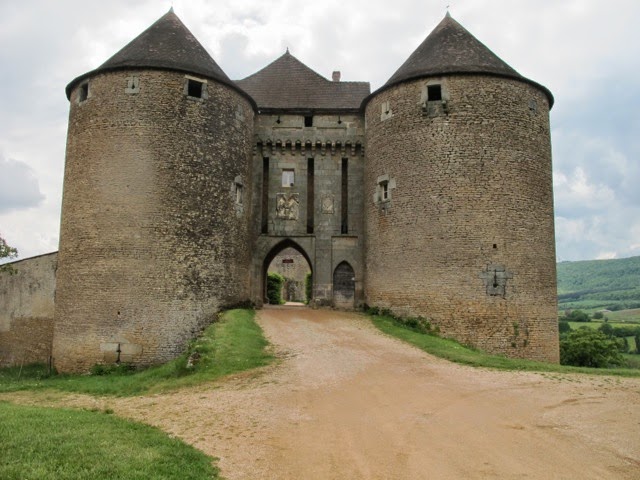
Castle of Berzé-le-Chatel in Burgundy
Burgundy is really lovely and I recommend it to just drive around aimlessly and stop where you like. We visited Cluny and saw the abbey there, but on the way to get to the abbey we came through Berzé-le-Châtel by accident, which was even more breathtaking with a castle perched on a hilltop. They started building this in the 1300's and it is the most impressive and best preserved fortress in Burgundy. The surrounding gardens were wonderful with wisteria creeping up the walls, lilac flowering and lots of wild flowers in the fields below.

This was meant to be just a quick trip to Strasbourg and back, but ended up being a wonderful tasting of the Burgundy countryside, a truly beautiful part of France. Given the beauty, the wonderful villages tucked away with ancient castles and churches, the great food and wine, and outstanding golf, there is something for everyone. It is a photographic and gastronomic delight. We started this trip in Provence and ended up in northeast France but it is equally doable starting in Paris, driving due east and then south to Burgundy. The three days were unrushed and lovely but we plan on redoing it again next year with more days to wander.

I encourage you to contact Travel 100 Group in Kenilworth (847-256-7570) or Northbrook, IL (847-897-7000) to learn more about this destination and to plan your next vacation.


- Petra Macintosh, Travel Consultant

Thursday, November 7, 2013

An Autumn in Paris


There are few things more enchanting than autumn in Paris. The air is crisp, the leaves have begun to turn, and vin chaud (hot wine) warms your hands and your soul. As soon as my husband, Justin, and I arrived in Paris in mid-October it felt as if someone had switched on bright lights and turned up the music--cancan, of course.

As a general rule, we often pack a lot into our travel. Unless our feet hurt and we collapse on the bed at the end of each night, we tend to feel unsatisfied. While Justin and I had both previously visited the “City of Light,” this trip was no exception. The hours passed in what felt like minutes, hitting our “must-see” spots while also delving deeper into the distinct personalities of each neighborhood.

That said, in four nights we barely scratched the surface of this gorgeous and fascinating city.


Arc de Triomphe
True to form, we hit the ground running. We began our trek walking along the Seine River, crossed over to the Right Bank, and admired the iconic view of the Eiffel Tower from the Jardins du Trocadéro. The area was buzzing as the 20 kilomètres de Paris running event was taking place the following day. We made our way over to the Arc de Triomphe, an imposing structure honoring French victories and the soldiers who were lost in battle. I maintain there are few things more suspenseful than watching the cars navigate the traffic circle at La Place Charles de Gaulle, weaving in and out and eventually spilling onto one of the twelve surrounding avenues. Not to mention the tourists that risk life and limb to get that great photograph!

We continued on to the famed Champs-Élysées, with its spectacular tree-lined streets, high end shopping, and exceptional people watching. It is important to note at this point we began embarking on our search for the perfect French macaron and enacted a strict, regimented diet of French cuisine and nothing else. It was a difficult, but noble task. We loved it. First stop: mussels.

The expansive Jardin des Tuileries provided a great relaxation point, as small vendor stands offered up hot chocolate, mulled wine, and roasted chestnuts on 
Stained glass in Notre Dame Cathedral
this particularly nippy day. We continued on to the Notre Dame Cathedral where an evening mass was taking place, the sounds of music and prayer bursting through the expansive halls. The day’s final sun flooded through vibrant, stunning stained glass windows throughout. Raised on the Disney classics, it took a great deal of self-control to keep myself from breaking into song from the musical “The Hunchback of Notre Dame” while inside the cathedral. (So naturally, I waited until we were outside.)

We sat on the tip of the island inhabited by Notre Dame, Île de la Cité, in the company of other young couples who came prepared with wine and snacks to view the romantic sunset. It was wonderful to relax and see the grandeur of the city lights at night. We topped off our evening with dinner in the vibrant Latin Quarter, and of course, we made sure to sample several different flavors of French macarons while walking past the magical (on-the-hour) twinkling lights of the Eiffel Tower.

The following day, we ventured slightly out to the Montmartre area in order to see the Sacré-Cœur Basilica and surrounding neighborhood. While there are admittedly a good number of tourist-oriented sites of this area, you can easily find more authentic pockets which appeal to the fascinating bohemian culture and personalities of the late 19th-early 20th century Belle Époque.

Crowd gathered for a performance outside of Sacré Cœur
In that vein, we opted to first visit the Musée de Montmartre. The museum is located in buildings over 300 years old, which served previously as home to Renoir as well as other famed artists and writers. The collection included paintings, photographs, posters and manuscripts telling the story of this eclectic neighborhood. We particularly enjoyed the works by Toulouse-Lautrec depicting the colorful lives of the bohemian performers and cabaret patrons.

As fans of the quirky French film, “Amélie,” we went in search of Café des Deux Moulins, the small café where the title character worked as a waitress. We took great joy in cracking the top layer of crème brulee, an act which Amelie’s character described as one of the greatest pleasures of life, and observed the Sunday afternoon espresso-fueled local buzz.

We briefly swept through the Quartier Pigalle to catch a glimpse at the iconic red windmill of the Moulin Rouge (cue more singing here) and toured the nearby Musée de l’Érotisme. While I cannot say I would recommend it, it was an eye opening experience to say the least. Not for the faint of heart.

A true highlight of the day was attending the Montmartre Wine Harvest Festival, an annual neighborhood happening since 1934. We sampled regional wines and artisan baguettes and cheeses while enjoying local music, dancing, and street performances.

Hoping to take things a bit more slowly, we spent the next day roaming around some of the nearby areas. We especially enjoyed Le Marais, a neighborhood formerly home to the Jewish population of Paris, now home to a thriving gay community. The area had a feel similar to the Mission District of San Francisco, an area known for its hip community, offbeat boutiques, and trendy restaurants. There are no shortage of bakeries, coffee shops, and art galleries to pore over.
It is just a short metro ride from Le Marais over to the university campuses of the Sorbonne and the eclectic, buzzing perpendicular Boulevards Saint-Michel and Saint-Germain.  Headed down the Boulevard Saint-Germain in search of the famous café, Les Deux Magots, we run into none other than Lenny Kravitz dining al fresco, looking as cool and famous as you would imagine in person.

Eiffel Tower

Along the Boulevard Saint-Germain we happened upon Restaurant La Jacobine for dinner. Tucked away in an unassuming alley, the restaurant features no more than 10 tables and serves up a mouth-watering French onion soup, Coq au vin, and escargot. Very highly recommended.

To commemorate our final evening, we ascended to the summit of the Eiffel Tower where we experienced the hourly twinkling lights from inside. (It is highly recommended you purchase your lift ticket as far in advance as possible!) Despite the late night chill, we watched the Eiffel Tower sparkle one last time from the ground before treating ourselves to an obligatory crepe with nutella and strawberries. Heaven.

We began our final day indulging in a morning espresso and delicious Croque Madame. With our hunger for French cuisine satiated, we spent the day gazing, mouths half open, at the magnificent impressionist and post-impressionist paintings at the Musee d’Orsay. The structure of the museum itself is breathtaking, as it formerly served as a train station built for the 1900 World’s Fair. Their collections are rather substantial with works from Monet, Manet, Degas, Renoir, Cézanne, Seurat, Sisley, Gauguin, Van Gogh, and Toulouse-Lautrec; however, the museum itself is quite manageable in a few hours or a half-day.
Musée d'Orsay Clock in the Main Hall
It is true that Paris is one of the most romantic cities the world, and with good reason. There is romance in the atmosphere—the music, the cuisine, the art, the history, the people. No wonder it serves as the setting for some of our most charming, beloved films. Needless to say, it was hard to board that return flight. Au revoir, Paris, until we meet again!

    --Jennie Reed, Travel 100 Group 

Monday, June 22, 2009

PROVENCE


When I think of Provence, this beautiful region of France, I envision rolling hills covered with vineyards, fields of lavender, olive groves and wild thyme. I think of a slow pace of life and Sunday brunch with friends at a sidewalk café in a small village tucked on the side of a mountain. Like Cezanne and Van Gogh, once you visit this spectacular region of France you will never forget the divine smells and enchanting sites.

Food is a simple delight in Provence and outdoor markets are a way of life here where you can taste and buy local cheeses, olives, sausages, fresh truffles.

The boutique hotels are delightful in Provence stylish and small but staying consistent with the charm and beauty of the region. Personable guesthouses and country houses are abundant.

Things to do on any given day in Provence:

London

  • Take a hike in the surrounding hills

  • Rent a bike and ride around the Mont Ventoux, or climb up to the top like the participants of the Tour de France.

  • Visit the charming towns of Arles, Avignon, St Remy de Provence, Vaison la Romaine.

  • Enjoy the local vineyards and sample the wine.

  • Take a rest and have a pastis, an aperitif, under the shade of a plain tree.

  • My clients love antiquing, either in L'Isle sur la Sorgue or at one of the many "brocantes" or flea markets held in the different towns or villages.

- Francoise Friedman, T100G Travel Consultant